What would you like to see on Trollosophy? Or happen in the Philosophy Department this year?
In the past, we've have films and special speakers and are contemplating more this year. Any suggestions?
We would love to hear from you, here and in person.
Be sure to vote in the poll, above. And please post your comments here!
26 August 2007


21 August 2007
Autobiographical Snapshot
Students in Senior Seminar, and perhaps especially in my PHIL 202 History of Philosophy II course, might be intrigued by the first installment of my philosophical autobiography, available here. They are my reflections on 'why I love modern philosophy,' or more precisely, what I love about modern philosophy.
Over the next couple of weeks we hope to post more such autobiographical reflections (or links to them) from other faculty members. If you would like to post one yourself, contact me and I can arrange to post it here, on Trollosophy.
Over the next couple of weeks we hope to post more such autobiographical reflections (or links to them) from other faculty members. If you would like to post one yourself, contact me and I can arrange to post it here, on Trollosophy.
PHIL 401 & 402 Senior Seminar: Philosophical Autobiography
Last year we began offering a senior seminar (PHIL 401 & 402), a year-long experience integrated into the department's normal colloquium. Senior students are invited (now, but by 2009, required) to join the full-time members of the department as we explore a topic together. Each year the topic changes, but it should always be something of a 'capstone experience' to the major, helping students reflect back on their Trinity experience with a comprehensive vision and challenge for the future. The faculty participate, too, as we hope it have the atmosphere of a graduate-level seminar (though probably less formal).
I, Professor Lake, am coordinating the seminar this year and our topic will be Philosophical Autobiography. The vision is to explore the writings of philosophers about their own lives as philosophers. Most of our readings will come from contemporary philosophers in three helpful volumes of personal reflections by leading voices in the field:
There will be a couple of other reserve readings as well.
The literary history of philosophical autobiography is rich. I would argue (though some might dissent) that both Augustine (in his Confessions) and Boethius (in his Consolation of Philosophy) are doing the kind of work that philosophical autobiography does, or ought to do. I think they are more than that, but they are not less than autobiography as well. For them, I think it is important to note, the autobiographical aspect of their writing was not the aim of the text but it was more of a mode in which they confessed a philosophical and theological outlook.
To begin the conversation, we faculty are going to post some of our own reflections. I've already written one and will post it next, here on Trollosophy.
The literary history of philosophical autobiography is rich. I would argue (though some might dissent) that both Augustine (in his Confessions) and Boethius (in his Consolation of Philosophy) are doing the kind of work that philosophical autobiography does, or ought to do. I think they are more than that, but they are not less than autobiography as well. For them, I think it is important to note, the autobiographical aspect of their writing was not the aim of the text but it was more of a mode in which they confessed a philosophical and theological outlook.
Today, we do not have as rich a literature, perhaps, as these luminaries. And to be sure, the authors we read usually will have less of a philosophical task in mind than either Augustine or Boethius did. We will take our cue, I suspect, more from the contemporary writers than from the historical ones. Students and faculty alike will be asked to reflect on their own lives in philosophy, seeking to understand the work of God in their lives through philosophy.
To begin the conversation, we faculty are going to post some of our own reflections. I've already written one and will post it next, here on Trollosophy.
Welcome Back!
The Philosophy Department welcomes all students back to Trinity. If it is your first semester at Trinity, a special welcome to you! We have a great set of courses on offer this semester and as a department we are eager to interact with each of you, inside and outside of the classroom.
Return to Trollosophy over the next few weeks for new posts on the courses we are offering and other news and opportunities from the philosophy department this fall.
Again, welcome back! Welcome to Trinity! Welcome to Trollosophy!
Return to Trollosophy over the next few weeks for new posts on the courses we are offering and other news and opportunities from the philosophy department this fall.
Again, welcome back! Welcome to Trinity! Welcome to Trollosophy!
09 April 2007
Nietzsche Lecture

The Trinity philosophy department is honored to be hosting Prof. Bruce Ellis Benson, the chairman of the Wheaton College philosophy department, for a public lecture on Monday, 16 April at 3:30 in CL 203.
 His lecture title is: "Pious Nietzsche: From Christianity to Dionysian Pietism." You won't want to miss his fascinating talk. Dr. Benson is a Nietzsche scholar, whose forthcoming book seeks to engage Nietzsche critically and constructively from a Christian philosophical standpoint.
 From his web page at Wheaton College:
Dr. Benson's research interests include the following areas. The first is the "theological turn" in phenomenology and work at the intersection of continental philosophy and theology. Not only does he write in this area, but also he is co-founder and co-secretary of the Society for Continental Philosophy and Theology (1997) and a member of the steering committee of the Theology and Continental Philosophy Group of the American Academy of Religion. Graven Ideologies and The Phenomenology of Prayer are examples of work in this area. The second is the topic of hermeneutics and interpretation theory, with Hermeneutics at the Crossroads being an example of that work. A third area is aesthetics in general and philosophy of music in particular. The Improvisation of Musical Dialogue is an example of that interest. Finally, Dr. Benson's work has also turned in an increasingly political direction. The forthcoming Evangelicals and Empire--an analysis of American evangelicalism from the perspective of the empire theory of Michael Hardt and Antonio Negri-is part of that project.Again, the lecture will be held at 3:30 in CL 203. For more information, please see or contact Prof. Stephen Lake.
NEW in Fall 2007! Symbo Limbo (PHIL 299)
You may have noticed a change in the schedule from PHIL 206 Logic to PHIL 299 Symbolic Logic—or Symbo Limbo, as I and other logic aficionados affectionately call it.
Here are answers to some Frequently Asked Questions (FAQs) about this change:
Question: Uh, why did you do it?
Answer: Because some students wanted it. And, really, it is about time it be taught again. Symbo limbo is an important type of logic and our current PHIL 206 does not cover much of it. In fact, it ends with a brief dabble in symbo but it’s hardly enough to count as a full-fledged symbo limbo.
Question: What exactly is the difference between the 206 Logic and Symbo Limbo?
Answer: 206 is more of a 'critical thinking' course, covering informal logic, fallacies and traditional Aristotlean logic (e.g., Venn diagrams, square of opposition, categorical propositions and inferences). We conclude with a teensy weensy bit of the more contemporary symbolic logic. Thus, the 299 course will, in effect, pick up where 206 topically left off. Symbo limbo is strictly formal logic with a more mathematical feel. They’re both VERY, VERY FUN!
Question: Is 206 a pre-requisite for Symbo Limbo?
Answer: No.
Question: Is Symbo Limbo harder than 206?
Answer: No. Or at least, not necessarily. If you find formal, analytical reasoning difficult, you may be more challenged by 299 than 206. If you have a ‘mathematical mind,’ you’ll positively LOVE Symbo Limbo. But don’t worry, even someone with NO BACKGROUND in LOGIC can take Symbo Limbo and get a lot out of it. We start out simple and work up from there!
Question: Will 299 count towards the Logic requirement of the philosophy major?
Answer: You bet.
Question: Are there plans to offer Symbo Limbo again?
Answer: Yes. In fact, I expect that we will add it permanently to the course catalog next year (as PHIL 207). It will then be offered every third year—i.e., at least once every 4 years.
Question: Will you offer 206 in 2008-9?
Answer: Yep. It'll be back, don't worry.
Question: Will I be a better person for having taken Symbo Limbo?
Answer: Undoubtedly so. I anticipate you will grow as a person, and not just intellectually in this course. I anticipate beginning class with a brief round of calisthenics—after all, you have to limber up first if you are going to do the limbo—plus a symbo limbo devotional. ; )
Question: What's next? The Logic Lambada?
Answer: Again, if there is a student demand for it, we shall respond. I would caution you against it, though: the lambada is, after all, the forbidden dance.
Here are answers to some Frequently Asked Questions (FAQs) about this change:
Question: Uh, why did you do it?
Answer: Because some students wanted it. And, really, it is about time it be taught again. Symbo limbo is an important type of logic and our current PHIL 206 does not cover much of it. In fact, it ends with a brief dabble in symbo but it’s hardly enough to count as a full-fledged symbo limbo.
Question: What exactly is the difference between the 206 Logic and Symbo Limbo?
Answer: 206 is more of a 'critical thinking' course, covering informal logic, fallacies and traditional Aristotlean logic (e.g., Venn diagrams, square of opposition, categorical propositions and inferences). We conclude with a teensy weensy bit of the more contemporary symbolic logic. Thus, the 299 course will, in effect, pick up where 206 topically left off. Symbo limbo is strictly formal logic with a more mathematical feel. They’re both VERY, VERY FUN!
Question: Is 206 a pre-requisite for Symbo Limbo?
Answer: No.
Question: Is Symbo Limbo harder than 206?
Answer: No. Or at least, not necessarily. If you find formal, analytical reasoning difficult, you may be more challenged by 299 than 206. If you have a ‘mathematical mind,’ you’ll positively LOVE Symbo Limbo. But don’t worry, even someone with NO BACKGROUND in LOGIC can take Symbo Limbo and get a lot out of it. We start out simple and work up from there!
Question: Will 299 count towards the Logic requirement of the philosophy major?
Answer: You bet.
Question: Are there plans to offer Symbo Limbo again?
Answer: Yes. In fact, I expect that we will add it permanently to the course catalog next year (as PHIL 207). It will then be offered every third year—i.e., at least once every 4 years.
Question: Will you offer 206 in 2008-9?
Answer: Yep. It'll be back, don't worry.
Question: Will I be a better person for having taken Symbo Limbo?
Answer: Undoubtedly so. I anticipate you will grow as a person, and not just intellectually in this course. I anticipate beginning class with a brief round of calisthenics—after all, you have to limber up first if you are going to do the limbo—plus a symbo limbo devotional. ; )
Question: What's next? The Logic Lambada?
Answer: Again, if there is a student demand for it, we shall respond. I would caution you against it, though: the lambada is, after all, the forbidden dance.
02 November 2006
Course Preview: PHIL 295 Major Author: Heidegger
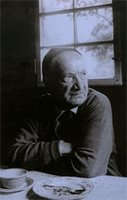 What is the meaning of being?
Astonishingly, the great philosopher Martin Heidegger argued that we have not ever even posed the question of the meaning of being. At least not in any radical way. So he set out to pose this question with all philosophical radicality, and not take its answer for granted any more. And his Sein und Zeit--Being and Time--is his first report back from his investigations. It stands as one of the truly monumental works of 20th century philosophy, and has exerted a contemporary influence wider than almost any other single text.

This spring we have the unique opportunity to offer a Major Author's course on Martin Heidegger, in which Being and Time will be the primary focus. A close reading course, Prof. Aron Reppmann will be your guide on this amazing journey. Heidegger's influence has been decisive upon contemporary Continental philosophy, upon theology and upon so-called postmodernism in the arts and culture in general. Any student interested in these issues will profit from this course.
PHIL 295 will meet Tuesdays and Thursdays at 9:30 AM.
01 November 2006
Course Preview: PHIL 321 Existentialism and Phenomenology
 Why is there something, rather than nothing?
What is the meaning of human existence?
After the excesses of modern rationalism and scientism, is there a meaning to be found? Can we recover a sense of the meaning of existence? Can we get back to the bedrock, the things themselves?
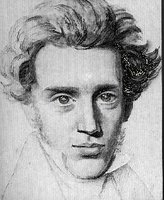
These questions motivated the movements of existentialism and phenomenology, the most profound influential tradition of contemporary Continental philosophy. They influenced so-called post-modern thinking in profound ways as well. The course will survey the writings of existential thinkers such as Kierkegaard (that's him in the picture!) as well as the phenomenological movement of Husserl and Heidegger.
Prof. Pierson teaches this course and has a great personal passion for these issues. His graduate work was in the philosophy of this period. He brings a keen sense of the Christian dimension to philosophical inquiry in this field, especially for the way that the Continental tradition has shaped the Reformational philosophical tradition that helped found Trinity.
Join him Tuesdays and Thursdays at 11AM.
PHIL 102 and 102 (or 108) are prerequisites for this course.
Course Preview: PHIL 201 History of Philosophy I
 From Thales to Democritus, from Socrates and Plato to Aristotle, from the Stoics to the neo-Platonists, and from St. Augustine (on the right) to St. Anselm and St. Thomas: PHIL 201 is an encounter with the figures and texts that have shaped our culture. It begins with the ancient Greeks and culminates in the Medieval synthesis of Christian faith and reason. This is an excellent course for anyone with a curiousity about the great ancient worldviews that helped shape Christian thought.
Prof. Aron Reppmann, an expert in the philosophy of Plato, teaches this course. He's passionate about Plato and the Platonic tradition, and will help you explore the riches of our ancient past. For him, as well as the ancients, philosophy is truly a love of wisdom.
Join Prof. Reppmann at 9AM MWF this spring!
(No prior background in philosophy is necessary, though PHIL 101 and 102 (or 108) are recommended.)
NEW in Spring 2007: Philosophical Theology (PHIL/THEO 311)
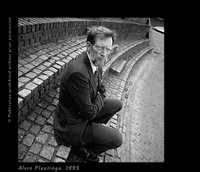 Alvin Plantinga,
Philosophical Theologian Extraordinaire
Ever wonder how evil and the goodness of God are compatible? How God responds to evil? And we should, too?
Ever wonder why we are free if God knows everything in advance, including what you are doing right this very instant? If you could never have chosen otherwise than God knows, are you really free?
Ever wonder about the mysterious nature of God? Of His being three-in-one? Being both human and divine in the incarnation of Jesus Christ?
These questions and more are all on the agenda in Philosophical Theology, a new course this spring taught by Prof. Stephen Lake, Tuesdays and Thursdays at 2 o'clock.
If you have completed PHIL 101 and 102, you are elligible to enroll.
If you are planning on seminary or graduate school in theology or philosophy, this course will be indispensible preparation.
Cross-listed in both Philosophy and Theology, it can count towards major, minor or elective credit in either department.
Any other questions? Please see Prof. Lake, or post your questions here and I will respond!
Subscribe to:
Posts
(
Atom
)